
Why leading with generosity isn't soft. It's strategic.

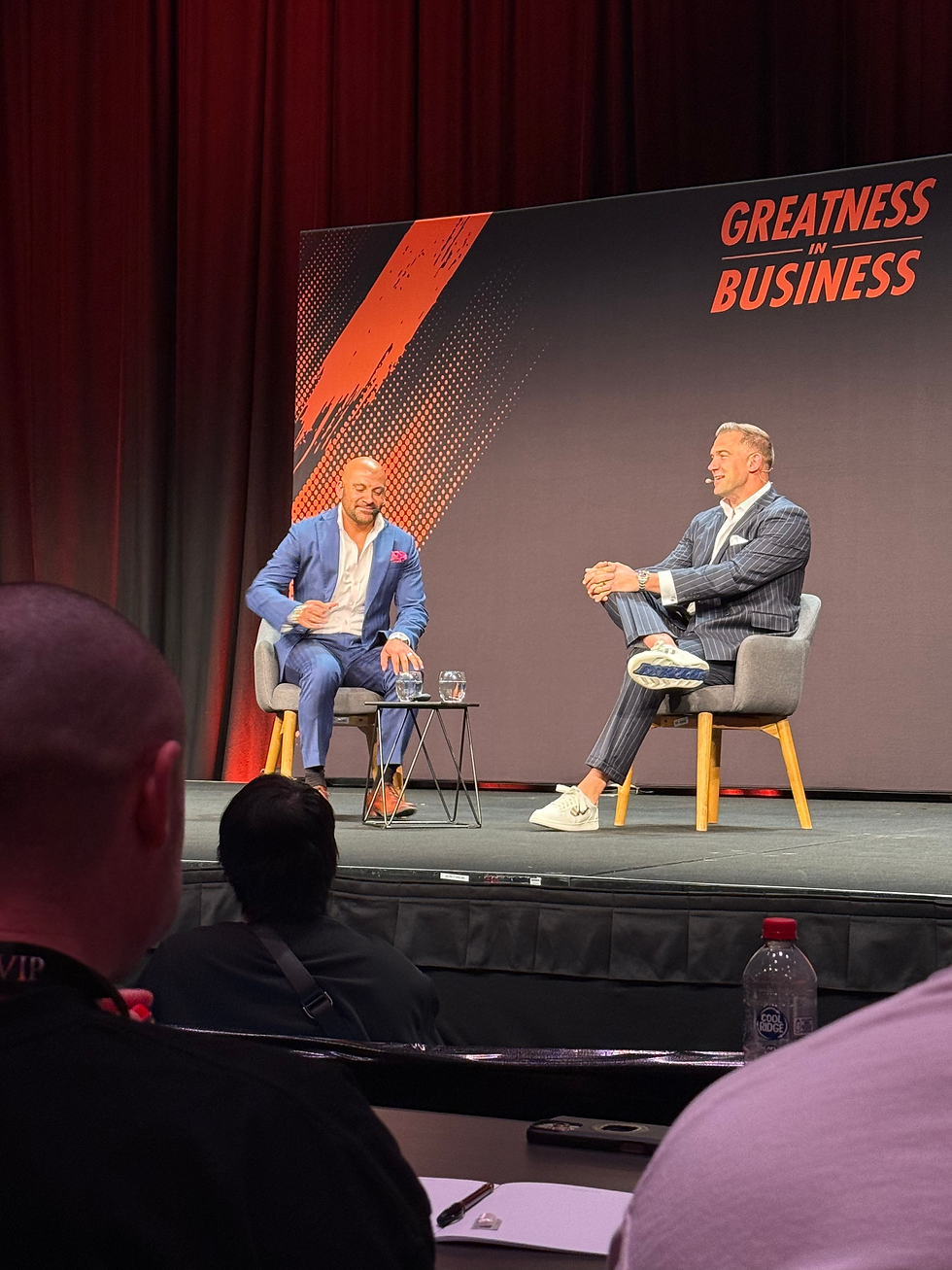
With Lewis Howes and Aaron Sansoni at the Greatness in Business event, Sydney.
If someone has told you that generosity and appreciation are nice-to-haves, not strategy, they've got it backwards. The leaders who get the hard results, the retention, the extra that people only give when they genuinely want to, the teams that actually want to be there, are almost always the ones who make their people feel seen. I was reminded of that this week, from an unexpected place.
I went into this week's Sydney event excited to hear Lewis Howes headline. What stood out wasn't the scale of his podcast or his business. It was his humanity. He kept coming back to three simple fundamentals: be generous, be grateful, and express appreciation often and specifically.
I sat there with two reactions at once. Affirmed, because this is the leadership and culture work I do every day. And challenged, because even those of us who teach it can practise it more deliberately.
So why are those "soft" habits anything but soft?
The numbers behind appreciation
People don't give their best to a leader who takes them for granted. That's not sentiment, it's data. Gallup's recognition research found that well-recognised employees are 45% less likely to have left after two years, and those who get high-quality recognition are nine times more likely to be engaged than those who get none. Yet only 22% of employees say they get the right amount of recognition, and more than half get none worth the name.
Sit with that gap for a second. Recognition is one of the cheapest, fastest levers a leader has, and most of it is going unused. Adam Grant's work on generosity points the same way: over time, the leaders who give, genuinely and without keeping score, build the trust that lets a team move faster and take smarter risks.
So the "soft skills" Lewis was talking about create very hard results: deeper trust, stronger culture, and teams that actually want to come to work.
But isn't this just being nice?
No. And this is where a lot of leaders get stuck. Kindness on its own is pleasant, but it isn't leadership. The strategic version pairs appreciation with clarity and high standards. You can be warm and demanding at the same time. In fact the warmth is what makes the standards land, because people will stretch for a leader they know is genuinely in their corner.
That's the difference between being liked and being followed.
What this looks like on a Monday
If you want to turn the volume up on this, and I walked out of that event determined to, here's where I'd start. None of it takes budget. All of it takes intention.
Make it specific. "Thanks for your work" lands as noise. "The way you handled that client on Thursday, calm, clear, no defensiveness, that's exactly the standard I want us known for" lands as fuel. Specific appreciation tells people precisely what to do more of.

Make it timely. Recognition a month later is a formality. Recognition the same day is a signal.
Make it a routine, not a mood. The leaders who do this well don't wait to feel grateful. They build it into how they run the week, so their team reads a consistent signal instead of a moods-dependent one.
And notice who you're not seeing. The quiet high performer who never asks for anything is usually the one going longest without a word of genuine appreciation.
Still a student of this work. Taking notes in the VIP section.
Why it matters more than it looks
Aligned leadership creates aligned teams. When people feel genuinely seen, and they're clear on exactly where they stand, they stop guessing and start performing. Generosity and clarity aren't opposites. They're the two halves of a leader people trust.
Lewis reminded me of something I already knew and needed to hear again: the human fundamentals aren't the soft part of leadership. They're the heart of it.
If you're looking at your team thinking "we could use more of this around here," that's worth paying attention to. The hard part isn't agreeing with it, it's doing it consistently when the week gets busy. That's exactly why I made 180 Second Leadership Impact, a free tool that turns this into a three-minute habit you can actually keep.
And I'd genuinely love to hear the small, specific ways you show your people they matter. Tell me in the comments.
Gabby.
Over 20+ years I've stood in rooms with tens of thousands of leaders and their teams across more than 15 industries, at conferences, offsites and group programs. In the last decade I've gone deep with more than 2,000 senior leaders, one-to-one and in leadership team alignments. I'm an authorised Australian distributor for Everything DiSC, with 700+ leaders profiled in depth.


Comments